Northern Cardinal
Cardinalis cardinalis
Family Cardinalidae
Quick answer
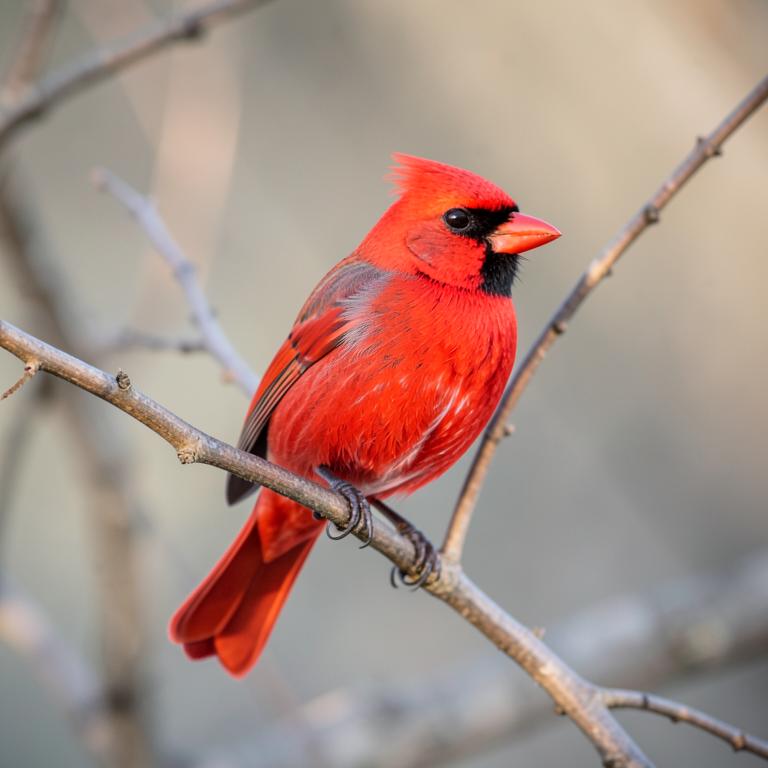
A heavy-billed, crested songbird of gardens, hedgerows and woodland edges across eastern and central North America. Males are brilliant red; females are warm buff-brown with red highlights.
Quick facts
- Size
- Between a sparrow and a robin, roughly 21–23 cm long
- Habitat
- Shrubby edges, gardens, thickets, woodland margins, suburban hedges
- Range
- Eastern and central United States, southern Ontario, Mexico and Central America; resident year-round
- Diet
- Seeds, grain, fruit and insects; readily takes sunflower seed at feeders
- When to look
- Year-round resident; song peaks late winter through summer
- Family
- Cardinalidae
Identification
- Prominent pointed crest, raised when alert
- Thick, conical, coral-red bill
- Male: uniform bright red with a black face mask around the bill
- Female: buff-brown with red wash on wings, tail and crest, and a red-orange bill
- Long tail, often held slightly down when perched
Behaviour
Usually seen low in cover, in pairs, hopping through shrubs or feeding on the ground beneath feeders. Both sexes sing, which is unusual among North American songbirds, and pairs frequently counter-sing across a territory.
Similar species
- Summer Tanager
- Male is red but lacks a crest and black mask, and has a paler, stouter bill.
- Pyrrhuloxia
- Southwestern; grey body with red trim and a stubby, strongly curved yellow bill.
- Scarlet Tanager
- Male has jet-black wings and tail against scarlet, and no crest.
Birding tips
- Listen for the loud, slurred 'cheer-cheer-cheer' and a sharp metallic 'chip' from deep cover
- Look at dawn and dusk, when cardinals are often the first and last birds active
- Photograph in shade — direct sun blows out red plumage badly
Frequently asked questions
Are female cardinals red?
Not overall. Females are warm buff-brown with red edges to the crest, wings and tail, and a red-orange bill.
Do cardinals migrate?
No. They are resident year-round throughout their range, which is why they're such a familiar winter feeder bird.
Have you seen this bird?
Record the sighting and it joins your life list.
Species information here is written by us. Your sightings, photos and notes stay yours, in your own journal.
More birds