American Goldfinch
Spinus tristis
Family Fringillidae
Quick answer
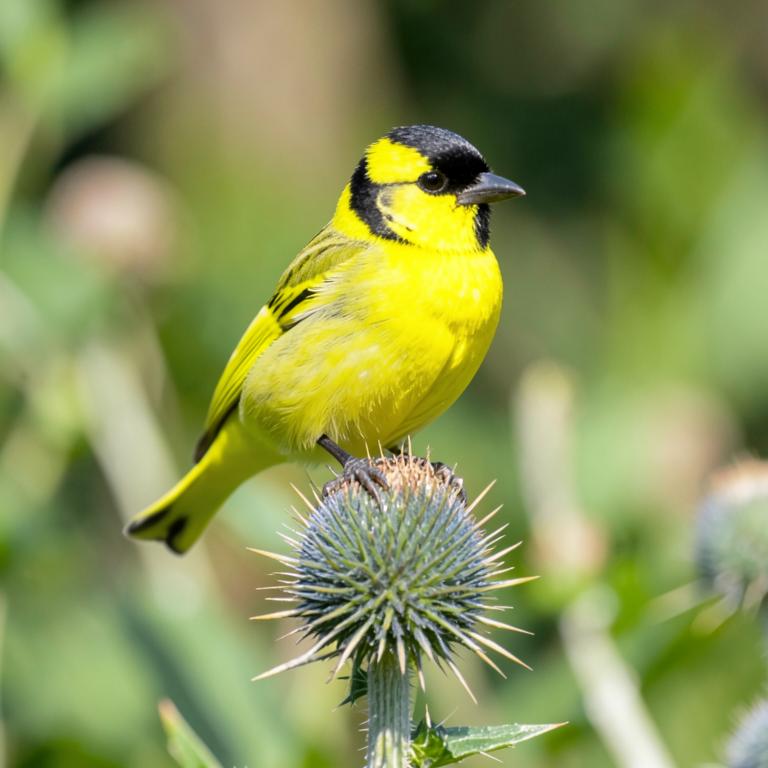
A small, bouncy finch of weedy fields, gardens and roadsides. Summer males are brilliant lemon-yellow with a black cap; winter birds are drab buff and confuse many beginners.
Quick facts
- Size
- Small, roughly 11–13 cm
- Habitat
- Weedy fields, thistle patches, gardens, woodland edges
- Range
- Across North America; northern birds withdraw south in winter
- Diet
- Almost entirely seeds, especially thistle and sunflower
- When to look
- Year-round in much of the range; breeds unusually late, often July–August
- Family
- Fringillidae
Identification
- Breeding male: bright yellow with black cap, black wings with white bars, orange bill
- Female and winter birds: buff to olive with blackish wings and pale wing bars
- Small conical bill
- Deeply undulating flight, usually with a 'po-ta-to-chip' call at each bound
Behaviour
Feeds acrobatically on seed heads, often hanging upside down. Breeds late in summer to coincide with thistle seed, and forms loose flocks the rest of the year.
Similar species
- Lesser Goldfinch
- Southwestern; darker back, no black cap on most males.
- Yellow Warbler
- Thin warbler bill, no black cap or black wings.
- Pine Siskin
- Streaky brown with yellow wing flashes; often in the same winter flocks.
Birding tips
- Leave thistle and coneflower seed heads standing through autumn
- Learn the flight call — you will detect far more goldfinches overhead than perched
Frequently asked questions
Where do goldfinches go in winter?
Mostly nowhere. They moult into dull buff plumage and are often overlooked at the same feeders.
Why do they nest so late?
They time nesting to the availability of thistle and other seeds, which they feed to their young.
Have you seen this bird?
Record the sighting and it joins your life list.
Species information here is written by us. Your sightings, photos and notes stay yours, in your own journal.
More birds